Elon Musk’s Starlink Achieves Historic Milestone: Ukraine Becomes First European Nation to Launch Revolutionary Direct-to-Cell Satellite Service
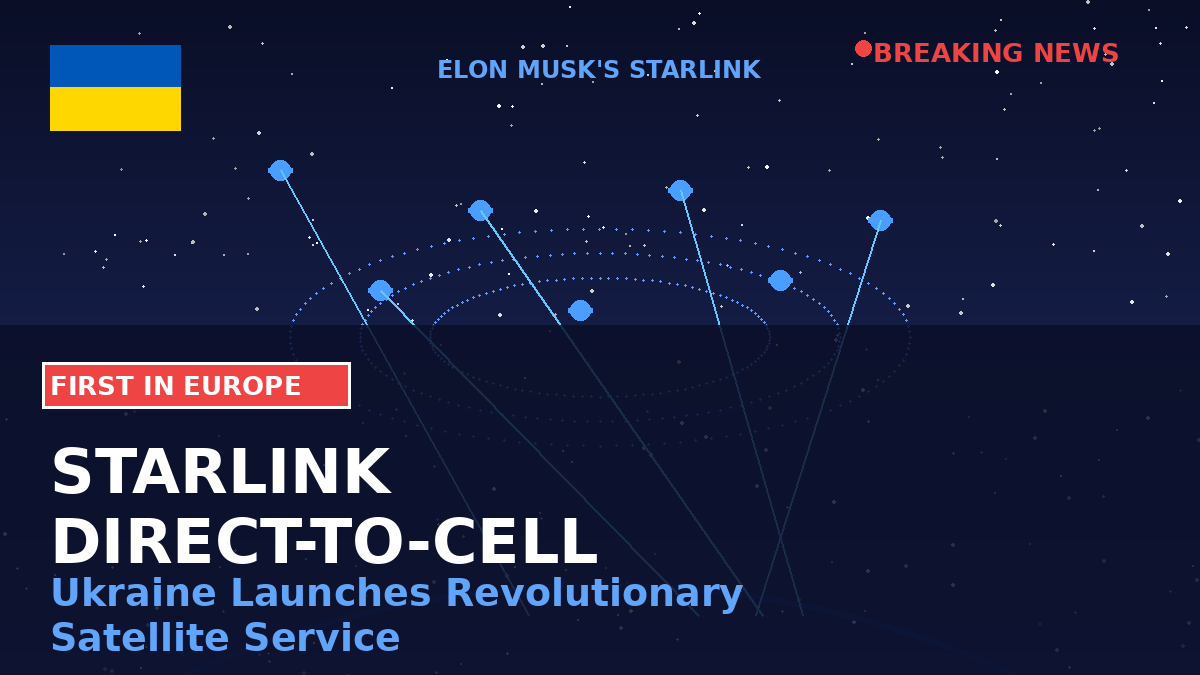
In a groundbreaking development that marks a pivotal moment for satellite communications and wartime resilience, Ukraine has officially become the first country in Europe to launch Starlink’s Direct-to-Cell satellite service. The revolutionary partnership between Kyivstar, Ukraine’s largest mobile operator, and Elon Musk’s SpaceX was announced on December 30, 2024, bringing a new era of uninterrupted connectivity to millions of Ukrainians facing ongoing infrastructure challenges.
A Game-Changing Technology in the Face of Adversity
The timing of this announcement carries profound significance. As Ukraine continues to navigate the challenges of war, with Russian forces repeatedly targeting critical communication infrastructure, Starlink’s Direct-to-Cell technology offers something unprecedented: connectivity that cannot be destroyed by conventional attacks. Unlike traditional cell towers and fiber-optic networks that remain vulnerable to missile strikes and cyber warfare, this space-based solution operates entirely beyond the reach of ground-based threats.
Kyivstar CEO Oleksandr Komarov described the partnership as transformative for the nation. “In Ukraine, staying connected means staying safe,” Komarov stated during the announcement. “With the introduction of cutting-edge Direct to Cell technology, we are enhancing network resilience significantly. This is more than backup—it’s a fully resilient, next-generation network architecture that ensures nothing stands between our customers and connectivity.”
How Starlink Direct-to-Cell Works: Breaking Down the Innovation
What makes this technology particularly remarkable is its simplicity from the user’s perspective. Unlike traditional Starlink satellite internet service that requires specialized dish equipment, Direct-to-Cell works with standard 4G smartphones that Ukrainians already carry in their pockets. There’s no need for additional hardware, app downloads, or service plan changes.
The system operates through Starlink’s low Earth orbit constellation, which now includes specialized satellites equipped with advanced cellular capabilities. These satellites essentially function as “cell towers in space,” beaming signals directly to regular mobile phones across vast distances. The technology represents years of development by SpaceX engineers who worked to miniaturize and adapt cellular technology for the unique challenges of space-based deployment.
For Kyivstar’s approximately 23 million mobile subscribers, the service will initially launch with SMS and messaging capabilities in late 2025, with voice calling and data services scheduled to follow in 2026. During the initial testing phase, Ukrainian subscribers will receive access to the service at no additional cost—a significant gesture given the country’s ongoing economic challenges.
Testing Success: From Laboratory to Real-World Implementation
The path to this historic launch involved rigorous testing across multiple stages. In June 2025, Kyivstar received regulatory approval from Ukraine’s National Commission for Electronic Communications to begin field testing. By August 2025, the first successful Direct-to-Cell test was conducted in the Zhytomyr region, where Kyivstar CEO Oleksandr Komarov and Ukraine’s Minister of Digital Transformation, Mykhailo Fedorov, exchanged the country’s first satellite-based text messages using ordinary smartphones.
“Ukraine has become the first country in Eastern Europe to conduct field testing of Direct to Cell technology,” Minister Fedorov announced at the time. “Despite all the challenges of wartime—constant Russian attacks on infrastructure, blackouts, and network damage—we continue to advance innovative solutions, because reliable connectivity under any circumstances remains one of our key priorities.”
The testing phase validated what engineers had long theorized: that integrating satellite and terrestrial networks could create a seamless connectivity experience. Kyivstar’s SIM cards proved fully compatible with the Starlink Direct-to-Cell system, requiring no modifications to existing subscriber equipment.
Strategic Importance Beyond Ukraine’s Borders
While Ukraine becomes the pioneering European nation for this technology, the implications extend far beyond its borders. The successful deployment in a conflict zone demonstrates Direct-to-Cell’s potential for emergency response, disaster relief, and connectivity in remote regions worldwide.
Kaan Terzioglu, CEO of VEON (Kyivstar’s parent company), emphasized this broader vision: “Our partnership with Starlink integrates terrestrial networks with satellite platforms, ensuring that nothing stands between our customers and connectivity—not power outages, deserts, mountains, floods, earthquakes, or even landmines. For Kyivstar and Ukraine, we are redefining what reliable connectivity means in humanitarian and crisis situations.”
The technology addresses a critical vulnerability exposed by modern warfare: the ease with which communication infrastructure can be targeted and disabled. Throughout Russia’s invasion, Ukraine has experienced numerous large-scale cyber attacks on its telecom networks. Most notably, in December 2023, Kyivstar suffered what CEO Komarov called “one of the largest attacks against a civilian communications system,” disrupting service for millions and costing the company nearly $100 million.
Elon Musk’s Vision: From Starlink Terminals to Direct Cellular Integration
This latest development represents an evolution of Elon Musk’s long-standing support for Ukrainian connectivity. Since February 2022, shortly after Russia’s invasion began, SpaceX has provided Ukraine with approximately 42,000 Starlink terminals, which have proven crucial for military communications, hospital operations, business continuity, and humanitarian aid coordination.
However, the Direct-to-Cell service marks a significant advancement over those initial terminals. While Starlink terminals require power sources, clear sky views, and stationary positioning, Direct-to-Cell works anywhere a user can access their mobile phone—in bomb shelters, underground metro stations, moving vehicles, or remote rural areas where infrastructure has been completely destroyed.
The service also represents Starlink’s broader commercial strategy. According to Wikipedia’s comprehensive Starlink overview, the constellation now comprises over 7,600 active satellites serving more than 5 million customers across 150 countries. The addition of Direct-to-Cell capabilities positions Starlink to compete directly with traditional mobile carriers while leveraging its unique orbital infrastructure advantage.
Technical Challenges and Future Expansion
Despite the celebration surrounding the launch, significant technical challenges remain. The physics of satellite-to-phone communication present unique obstacles that don’t exist with terrestrial cell towers. Satellites in low Earth orbit travel at approximately 27,000 kilometers per hour, requiring sophisticated handoff algorithms as phones switch between satellite connections every few minutes.
Additionally, the bandwidth available through Direct-to-Cell satellites is currently limited compared to 4G and 5G towers. This explains why the rollout begins with text messaging—the lowest bandwidth application—before expanding to voice and eventually data services. SpaceX engineers continue working on advanced compression algorithms and satellite antenna designs to increase capacity.
Weather conditions also present challenges. While Starlink’s Ka-band frequencies work well in clear conditions, heavy rain and snow can temporarily degrade signal quality. However, the redundancy built into the satellite constellation means that multiple satellites are typically visible from any location, providing backup connections if one path is compromised.
Investment and Infrastructure Development
The Kyivstar-Starlink partnership is backed by substantial financial commitments. VEON has invested more than $10 billion in Ukraine since 2013 and pledged an additional $1 billion specifically for digital infrastructure restoration and development between 2023 and 2027. This investment encompasses not only satellite connectivity but also 4G network expansion, energy resilience infrastructure including batteries and generators providing up to 10 hours of backup power, and cybersecurity enhancements.
These investments have positioned Kyivstar as Ukraine’s connectivity backbone throughout the war. The company maintains network availability above 90% on average—a remarkable achievement given the ongoing attacks on infrastructure. Their ability to now integrate satellite connectivity creates a truly hybrid network that combines the best attributes of terrestrial and space-based systems.
Global Implications and Competitive Landscape
Ukraine’s first-mover advantage with Direct-to-Cell technology in Europe is likely to spark rapid adoption across the continent. Other mobile operators are watching closely, and regulatory frameworks are being developed to accommodate this new category of telecommunications service.
The technology also represents a strategic counter to competing satellite internet initiatives from other nations. China, for instance, has announced plans for three major low Earth orbit satellite constellations—Qianfan, Guo Wang, and Honghu-3—totaling approximately 38,000 satellites. While these systems are still in early development stages, they highlight the growing recognition that space-based communications infrastructure represents a critical geopolitical and economic asset.
Similarly, European-based Eutelsat OneWeb and Amazon’s Project Kuiper are developing competitive satellite internet services. However, none have yet matched Starlink’s combination of constellation size, launch cadence, and now, direct cellular integration capabilities.
Looking Ahead: A New Paradigm for Global Connectivity
As Ukraine prepares for the commercial launch of SMS services in late 2025, the broader implications of this technology are coming into focus. Beyond emergency and military applications, Direct-to-Cell could fundamentally reshape how mobile networks are designed and deployed globally.
For rural and remote communities worldwide, the technology promises to eliminate the “last mile” connectivity problem that has plagued telecom infrastructure development for decades. Instead of extending fiber-optic cables or building cell towers in sparsely populated areas, operators can simply integrate satellite connectivity as a standard network component.
The humanitarian applications are equally compelling. During natural disasters, when terrestrial infrastructure is destroyed, Direct-to-Cell could maintain emergency communications for rescue operations and displaced populations. Maritime and aviation applications could provide passengers with seamless connectivity regardless of location.
Ukraine’s pioneering role in this technology rollout stems from necessity—the urgent need for resilient communications infrastructure in a wartime environment. However, the lessons learned and technologies validated in Ukraine will inform connectivity solutions for peaceful applications worldwide for years to come.
As Elon Musk continues expanding his satellite constellation and refining the Direct-to-Cell technology, Ukraine stands as proof of concept for what the future of mobile communications might look like: a seamless integration of terrestrial and satellite networks providing truly universal connectivity that no amount of conventional infrastructure damage can disrupt.
For the millions of Ukrainians who will soon send their first text messages through satellites orbiting 550 kilometers overhead, this technology represents more than an engineering achievement. It represents resilience, innovation, and the determination to remain connected to each other and the world, regardless of the challenges they face.