
How Starlink Technology Works: A Deep Dive
Quick Answer: How Does Starlink Technology Work?
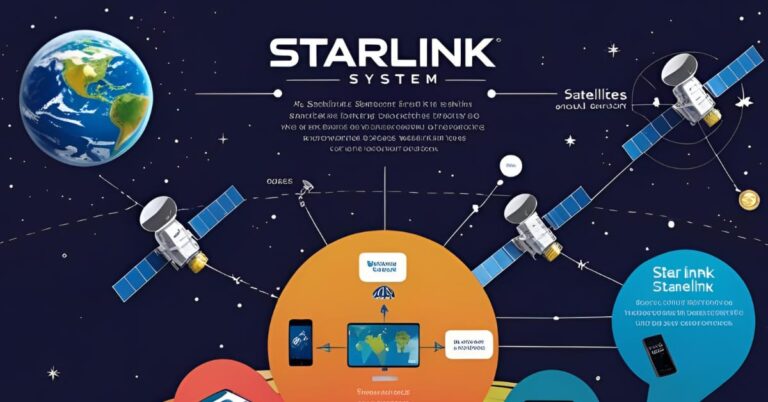
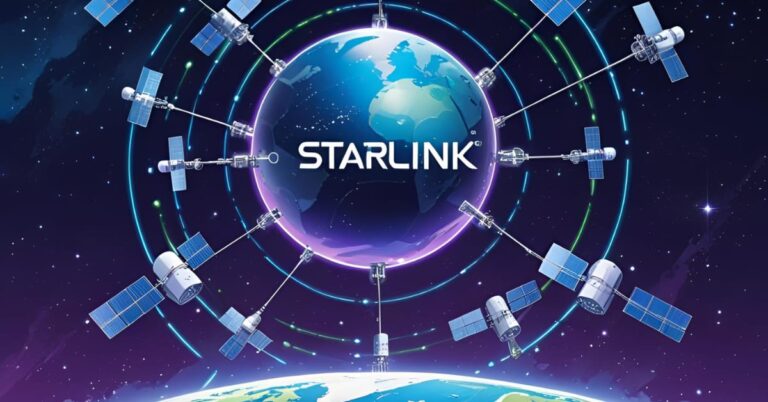
Starlink works by using a constellation of over 7,600 low Earth orbit satellites positioned at 550km altitude that communicate with user terminals (dishes) via phased array antennas. Data travels from your dish to a satellite overhead, then routes through laser inter-satellite links or to nearby ground stations, connecting to the internet backbone with latency as low as 25-50ms.
The promise of global, high-speed internet has long seemed like a distant dream for millions living in remote and underserved regions. Traditional broadband infrastructure requires extensive cable networks that are economically unfeasible in sparsely populated areas. Enter Starlink—SpaceX’s revolutionary satellite constellation that’s fundamentally changing how we think about internet connectivity.
Since its first satellite launch in 2019, Starlink has grown from an ambitious concept into the world’s largest satellite constellation, with over 7,600 satellites currently orbiting Earth and serving more than 8 million subscribers across 150 countries. But what makes this system so different from previous satellite internet attempts? The answer lies in a sophisticated combination of aerospace engineering, advanced electronics, and network architecture that represents one of the most significant technological achievements of our era.
Key Starlink Technology Statistics (2024-2025)
- Satellites in Orbit: 7,600+ active satellites (65% of all satellites globally)
- Orbital Altitude: 340-550 km (Low Earth Orbit)
- Satellite Speed: 27,000 km/h relative to Earth’s surface
- Latency: 25-50 milliseconds average
- Download Speeds: 90-160 Mbps (residential)
- Upload Speeds: 10-40 Mbps
- Active Subscribers: 8+ million worldwide
- Coverage: 150+ countries and territories
- Phased Array Elements: 1,280 antenna elements per user terminal
- Laser Link Speed: Up to 200 Gbps between satellites
- Ground Stations: ~150 operational globally
- Frequency Bands: Ku-band (12-18 GHz), Ka-band (26.5-40 GHz)
The Foundation: Low Earth Orbit Satellites
Understanding how Starlink technology works begins with recognizing its fundamental departure from conventional satellite internet. Traditional providers rely on geostationary satellites positioned approximately 35,786 kilometers above Earth’s surface. While these satellites remain fixed relative to a point on the ground, their extreme altitude creates a critical problem: latency.
| Technology Aspect | Starlink (LEO) | Traditional Satellite (GEO) |
|---|---|---|
| Orbital Altitude | 550 km (Low Earth Orbit) | 35,786 km (Geostationary Orbit) |
| Latency | 25-50 ms | 600+ ms |
| Number of Satellites | 7,600+ active satellites | 1-2 satellites |
| Satellite Movement | Moving at 27,000 km/h | Stationary relative to Earth |
| User Terminal Type | Phased array (electronic steering) | Parabolic dish (fixed pointing) |
| Inter-Satellite Links | Optical lasers at 200 Gbps | None (relies on ground stations) |
| Coverage Method | Constellation of satellites | Single satellite coverage zone |
| Typical Download Speed | 90-160 Mbps | 12-100 Mbps |
| Best Use Cases | Gaming, video calls, streaming, remote work | Basic browsing, email (not real-time apps) |
When you send a request from your computer, the signal must travel up to the satellite and back down—a round trip of over 71,000 kilometers. Even at the speed of light, this journey takes roughly 600 milliseconds, making real-time applications like video calls, online gaming, or cloud computing frustratingly slow or entirely impractical.
Why Low Earth Orbit Changes Everything
In contrast, Starlink satellite technology takes a radically different approach. The constellation operates in low Earth orbit at altitudes between 340 and 550 kilometers. This is nearly 100 times closer to the planet’s surface. As a result, this proximity slashes latency to approximately 25-50 milliseconds. This is comparable to many terrestrial fiber connections. Furthermore, it’s fast enough for demanding applications that require instant responsiveness.
The Speed Challenge of LEO Satellites
However, this proximity comes with its own engineering challenge. Low earth orbit satellites move at tremendous speeds—approximately 27,000 kilometers per hour. A satellite passes over any given location in just a few minutes. Then it disappears below the horizon. To maintain continuous coverage, Starlink doesn’t rely on one or two satellites. Instead, the system employs thousands of satellites working in coordinated shells. This ensures that multiple satellites are always visible from any point within the coverage area.
Satellite Constellation Architecture
Orbital Shell Design
The Starlink network architecture represents a masterpiece of orbital mechanics. Satellites are distributed across multiple orbital shells at different inclinations. These include 53 degrees, 70 degrees, and 97.6 degrees relative to the equator. The majority of operational satellites occupy the 53-degree shell. This provides coverage for most populated regions. Meanwhile, higher inclination orbits extend service to polar regions. These are areas that traditional satellite systems struggle to reach.

Satellite Design and Manufacturing
Each Starlink satellite weighs approximately 260 kilograms. Moreover, it features a flat-panel design that maximizes packing efficiency during launch. SpaceX’s Falcon 9 rockets can deploy up to 60 satellites in a single launch. Consequently, this makes the system economically viable through mass production and frequent deployment schedules. The satellites are manufactured at SpaceX facilities in Redmond, Washington. They use production techniques borrowed from the automotive industry. This is a revolutionary approach in an aerospace sector traditionally characterized by custom, handcrafted spacecraft.
Advanced Satellite Technology
The satellites themselves are technological marvels. Each unit is equipped with four powerful phased array antennas. Additionally, they have two parabolic antennas for ground communication. They operate across Ku-band and Ka-band frequencies. Furthermore, efficient krypton-powered ion thrusters enable precise orbital maneuvering. They also handle collision avoidance and controlled deorbiting. This happens at the end of their approximately five-year operational lifespan. Solar panels provide power. The entire system is designed for autonomous operation. It can rapidly respond to potential hazards.
Phased Array Antenna Technology: The Heart of the System
Revolutionary User Terminal Design
Perhaps the most impressive innovation in how Starlink internet technology explained is the phased array antenna system. This technology was once limited to military radar and advanced research applications. However, it is now mass-produced for consumer use. SpaceX affectionately calls this innovation “Dishy McFlatface”—the user terminal.

Traditional satellite dishes are parabolic reflectors. They must physically point toward a satellite. As a result, they’re bulky and require professional installation. Additionally, they cannot track moving satellites without motorized gimbals. In contrast, Starlink’s user terminal is a sleek, pizza-box-sized device. It contains approximately 1,280 individual antenna elements. These are arranged in a hexagonal honeycomb pattern.
How Beamforming Works
The magic happens through a principle called beamforming. Each tiny antenna element transmits and receives signals with a precisely controlled phase shift. By coordinating these phase shifts across all 1,280 elements, something remarkable happens. The system can electronically steer a focused beam of radio waves in any direction. Importantly, this happens without any mechanical movement. Twenty specialized beamformer chips control this dance. Each one manages 32 front-end modules that handle pairs of antennas.
Tracking Satellites at High Speed
As satellites race across the sky at 27,000 kilometers per hour, the terminal dish technology works continuously. It recalculates the optimal beam angle using GPS data. It also uses knowledge of satellite orbital positions. The system reassesses and adjusts thousands of times per second. Therefore, it maintains a stable connection even as the satellite position changes. When one satellite moves out of range, something important happens. The terminal seamlessly hands off to another satellite entering its field of view. This process happens every few minutes without interrupting the user’s connection.
Benefits of Electronic Steering
This phased array beam steering represents a quantum leap in satellite communications efficiency. First, the electronic steering eliminates mechanical components prone to failure. Second, it enhances reliability in harsh weather conditions. Third, it allows the network to handle more users simultaneously. This works by optimizing signal strength and reducing interference.
Beamforming Technology: Precision at Scale
The beamforming technology employed by Starlink goes beyond simple signal focusing. Modern systems use adaptive beamforming algorithms. These can dynamically adjust to changing radio frequency environments. By analyzing signal quality in real-time, the system can modify beam patterns. Consequently, this maximizes signal-to-noise ratio. Additionally, it suppresses interference. Furthermore, it maintains connection quality even in challenging electromagnetic conditions.
Some cutting-edge implementations are even exploring artificial intelligence. They’re also using machine learning to predict optimal beam configurations. Neural networks can process environmental data. Moreover, they can predict the ideal antenna array weights needed to maintain peak performance. As a result, they adapt to interference patterns that would confuse traditional systems.
Laser Inter-Satellite Links: The Space-Based Internet Backbone
The Evolution from Bent Pipe Architecture
Early Starlink satellites operated as simple relay stations. They received signals from user terminals and immediately transmitted them to nearby ground stations. This “bent pipe architecture” had a significant limitation. It required that both the user and a ground station be within the satellite’s coverage zone. This zone extends approximately 1,000 kilometers. Consequently, this was a major challenge for serving remote regions far from terrestrial infrastructure.
Optical Communication Innovation
The solution came with one of SpaceX’s most ambitious technological innovations. These are optical intersatellite links, or space lasers. Starting with version 1.5 satellites, this technology continued through the current generation. Each Starlink satellite is equipped with three laser communication terminals. Remarkably, these are capable of transmitting data at speeds up to 200 gigabits per second.
Creating a Mesh Network in Space
These laser inter-satellite links create a mesh network in space. Instead of routing every user request through a nearby ground station, satellites can relay data to each other. For example, consider a user in the middle of the ocean. They can send a request to a satellite overhead. That satellite then forwards it through a chain of satellites using optical links. Eventually, it reaches another satellite with a ground station in view. The response travels back through this space-based network to the user.
Advantages of Space-Based Routing
This technology offers several profound advantages. First, it dramatically reduces dependence on ground station locations. This enables true global coverage even in the most remote regions. Second, laser communications in the vacuum of space experience virtually no signal degradation. As a result, they potentially offer lower latency than equivalent terrestrial fiber routes. Third, it provides redundancy. If one path is congested or unavailable, the network can dynamically route traffic through alternative satellite chains.
Overcoming Engineering Challenges
The engineering challenges were substantial. Free-space optical communication requires extraordinarily precise pointing. The laser must remain locked onto a target satellite. This target may be thousands of kilometers away. Meanwhile, both satellites hurtle through space at different velocities and orbital paths. Therefore, SpaceX developed sophisticated tracking systems. They also created vibration isolation to maintain these connections. This works even as the satellites maneuver to avoid debris or adjust their orbits.
Ground Station Network: The Terrestrial Connection
Critical Infrastructure Components
While the satellite constellation captures public imagination, the Starlink network architecture depends equally on its ground station infrastructure. These facilities serve as the critical bridge between the space-based network and the global internet backbone.
Starlink operates approximately 150 ground stations worldwide. These are strategically positioned to ensure satellites always have a gateway in view. Often, these facilities are located in rural or semi-rural areas. This provides minimal radio frequency interference. They feature arrays of large phased array antennas. These are housed within distinctive white radomes. These are dome-shaped structures that protect the sensitive equipment from weather. At the same time, they allow radio signals to pass through.
Connecting to the Internet Backbone
Each ground station maintains high-bandwidth fiber optic connections. These connect to internet exchange points. This is where Starlink’s private network connects to the public internet infrastructure. Site selection is crucial for several reasons. First, proximity to major fiber optic routes minimizes latency. Second, distribution across geographic regions ensures adequate coverage. Third, it provides load balancing capabilities.
Advanced Tracking Technology
The ground stations themselves employ advanced technology. Like the user terminals, they use electronically steerable phased array antennas. These are capable of tracking multiple satellites simultaneously. As satellites race overhead, the ground stations continuously hand off connections. Therefore, they maintain data flow without interruption. Redundant systems for power, communication, and data handling ensure continuous operation. This works even during equipment failures.
Next-Generation Capabilities
Recent developments include authorization for next-generation ground stations. These operate in E-band frequencies. Consequently, they promise significantly enhanced uplink and downlink speeds. SpaceX has filed applications for nearly 100 unique gateway sites. These span 40 U.S. states and territories. Similar expansion is underway internationally. This infrastructure buildout is essential to support the growing subscriber base. It also addresses increased data demands.
User Terminal Equipment: Bringing It All Together
Simple Setup Process
The user experience begins with the Starlink kit. This is a carefully engineered package designed for simplicity despite its sophisticated internals. The terminal dish arrives pre-configured and largely self-installing. Users simply place it where it has a clear view of the sky. They provide power, and the system handles the rest. For those ready to get started, our comprehensive guide on how to buy and set up Starlink walks through every step of the process.
Automatic Alignment and Connection
During initial setup, the terminal uses GPS to determine its precise location and orientation. It then calculates which satellites should be visible. Next, it begins scanning the sky electronically. As a result, it establishes connections without any manual pointing. The terminal’s software continuously monitors signal quality. Additionally, it automatically adjusts to optimize performance. Furthermore, it manages handoffs between satellites as they move across the sky.
Integrated Connectivity Features
The integrated WiFi router distributes connectivity throughout the home or business. It supports multiple devices simultaneously. Moreover, Power-over-Ethernet technology simplifies installation. It delivers both power and data through a single cable connection. Recent hardware iterations have introduced improvements in several areas. These include thermal management, weather resistance, and aesthetic design.
Specialized Applications
For specialized applications, SpaceX offers variants with enhanced capabilities. These include maritime terminals rated for extreme conditions. They feature IP69K water resistance. Additionally, they can tolerate wind exceeding 270 kilometers per hour. They are also qualified for 10-year service life in saltwater environments. Aviation and mobile vehicle solutions are under development. Some are already deployed. These extend Starlink’s reach to platforms that traditional satellite internet struggled to serve.
Network Routing and Performance Optimization
Software-Defined Networking
Behind the hardware lies sophisticated software that orchestrates the entire system. Starlink employs software-defined networking principles. This allows the network to adapt dynamically to changing conditions. Traffic routing algorithms consider multiple factors. These include current satellite positions, ground station availability, and network congestion. They also consider user location and quality of service requirements.

Intelligent Path Selection
The system performs continuous measurements of latency, packet loss, and throughput. It does this across all possible paths. Meanwhile, machine learning algorithms analyze historical performance data. Consequently, they can predict optimal routing decisions. For example, when a user in Manila accesses a local server, the system might route traffic through nearby satellites and ground stations. However, for international requests, the network might leverage space-based routes. These often offer lower latency than equivalent undersea cable paths.
Real-World Performance Improvements
This dynamic optimization was dramatically demonstrated in the Philippines. The deployment of a local point-of-presence in May 2023 immediately improved latency. Before the new facility, Philippine users accessing local content experienced high latencies. Their traffic routed to Japan via undersea cable before returning. However, the new infrastructure eliminated this inefficient path. As a result, it significantly enhanced user experience.
Frequency Bands and Spectrum Management
Starlink operates across multiple frequency bands, each chosen for specific characteristics. The Ku-band frequencies (12-18 GHz) provide the primary link between user terminals and satellites, offering a good balance of bandwidth, atmospheric penetration, and antenna size requirements. Ka-band frequencies (26.5-40 GHz) supplement this with additional capacity, particularly for ground station communications where larger antennas can take advantage of the higher frequencies.
More recently, SpaceX has begun exploring E-band frequencies (71-76 GHz and 81-86 GHz) for next-generation ground stations. These millimeter-wave frequencies offer enormous bandwidth potential, though they require line-of-sight conditions and are more susceptible to atmospheric absorption.
Managing spectrum efficiently is critical. Starlink employs sophisticated frequency reuse schemes, where the same frequencies are used simultaneously by different satellites or beams without creating interference. The phased array antennas’ precise beamforming capabilities enable this spatial separation, dramatically increasing overall network capacity.
Latency Reduction Technology: Closing the Gap with Fiber
One of Starlink’s most remarkable achievements is latency performance that challenges conventional assumptions about satellite internet. Multiple independent measurements confirm median latencies of 25-50 milliseconds for most users—comparable to many terrestrial broadband services and fast enough for applications that traditional satellite internet couldn’t support.
Several factors contribute to this performance. The low orbital altitude is primary, but not the only factor. The laser inter-satellite links actually offer a speed advantage over fiber optic cables. While light in vacuum travels at approximately 300,000 kilometers per second, light in optical fiber slows to roughly 200,000 kilometers per second due to the refractive index of glass. For long-distance routes, particularly those crossing oceans, the space-based path may actually be faster than the undersea cable alternative.
The network’s routing intelligence further reduces latency by selecting optimal paths and avoiding congested segments. Unlike traditional internet routing that may send traffic through multiple hops and intermediate networks, Starlink’s private network maintains control over the entire path from user to gateway, eliminating many sources of delay and variability.
Performance Metrics: Real-World Testing
Speed Test Results
Independent speed tests from Ookla and other services provide insight into actual performance. Median download speeds vary by region. However, they commonly range from 90 to 160 megabits per second. In some areas, users experience even higher speeds. Meanwhile, upload speeds typically fall between 10 and 40 megabits per second. This is adequate for most applications. Nevertheless, it’s generally lower than download speeds.
Application Performance Comparison
Comparative studies have found Starlink competitive with terrestrial broadband. This is particularly true for demanding real-time applications. For instance, video conferencing platforms like Zoom perform well. Similarly, cloud gaming through services like Amazon Luna works effectively. While peak speeds don’t match premium fiber connections, something important stands out. The consistency and low latency make the service viable for professional work-from-home scenarios. It also supports bandwidth-intensive entertainment.
Factors Affecting Performance
Performance does vary based on several factors. First, network congestion during peak hours can reduce speeds. This happens in areas with high user density. Second, weather conditions play a role. Particularly heavy rain or snow can degrade signal quality. This occurs due to atmospheric attenuation. Third, the user’s location relative to ground stations affects performance. Fourth, the current satellite constellation geometry also impacts results. Nevertheless, SpaceX continuously works to address these variations. They do this through satellite additions, ground station expansion, and software optimization.
Direct-to-Cell: The Next Frontier
Breaking the Mobile Phone Barrier
SpaceX’s ambitions extend beyond fixed broadband. In January 2024, the company achieved a significant milestone. They successfully sent and received text messages through Starlink satellites. Remarkably, this used standard mobile phones with no special equipment required. This Direct to Cell capability addresses one of satellite communication’s most challenging technical problems.
Overcoming Technical Challenges
Mobile phones are designed for terrestrial cell towers. These remain stationary. However, connecting to satellites moving at tremendous speeds requires overcoming multiple obstacles. First, there’s Doppler shift compensation to address. Second, rapid handoffs between satellites are necessary. Third, timing delays must be managed. Fourth, there’s the fundamental challenge that mobile phones have low antenna gain and transmit power.
Innovative Solutions
The solution involves custom silicon, sophisticated phased array antennas, and advanced software algorithms. These are deployed on specially equipped Starlink satellites. Essentially, these satellites act as cell towers in space. They provide LTE service in areas where terrestrial coverage is impossible. They also work during emergencies when ground infrastructure fails. Initially, services focus on text messaging. However, voice and data capabilities are planned for future deployment.
Space Sustainability and Debris Mitigation
Natural Deorbiting from Low Altitude
Operating the world’s largest satellite constellation brings responsibilities. These include space safety and sustainability. Starlink satellites orbit below 600 kilometers altitude. At this level, atmospheric drag naturally deorbits failed satellites. This happens within five years even without active control. However, SpaceX proactively deorbits satellites showing signs of potential failure. They do this before problems develop.
Collision Avoidance Systems
The constellation employs the most conservative collision avoidance thresholds in the industry. Autonomous maneuvering systems continuously monitor potential conjunction events. These are situations where satellites might come too close to space debris. They also monitor proximity to other spacecraft. When necessary, satellites execute avoidance maneuvers. Importantly, this happens without human intervention. Therefore, it ensures safe operations while minimizing disruption to service.
Transparency and Coordination
SpaceX publicly shares high-precision ephemeris data. This includes detailed information about satellite positions and trajectories. They share this with other operators and space agencies. Consequently, this transparency facilitates coordination. As a result, it reduces collision risks across the increasingly crowded orbital environment.
Addressing Light Pollution
Efforts to minimize light pollution have also been extensive. Early satellites proved problematic for astronomical observations. This was due to sunlight reflections. Through collaboration with the astronomy community, SpaceX developed innovative solutions. These include sun visors, orientation techniques, and special coatings. These reduce brightness while maintaining thermal and operational characteristics. While the sheer number of satellites remains a concern for some astronomers, there’s an important point. The industry-leading mitigation measures represent a significant commitment. They balance connectivity needs with scientific pursuits.
Broadband from Space: Impact and Applications
Emergency Response and Disaster Relief
The implications of reliable satellite internet technology extend far beyond individual users. They reach much further than people seeking better connections. In disaster response, Starlink terminals have provided emergency connectivity. This happens when conventional infrastructure failed. For example, from wildfire evacuations in Washington state to hurricane recovery operations coordinated by SpaceX.
Education and Healthcare Applications
Remote education initiatives leverage the service effectively. They bring online learning to students in areas where broadband previously didn’t exist. Similarly, telemedicine applications connect rural healthcare facilities with specialists in urban centers. Meanwhile, scientific research stations in Antarctica and other extreme locations maintain connections. These enable real-time data transmission and communication with the outside world.
Maritime Industry Transformation
The maritime industry has embraced Starlink enthusiastically. Commercial vessels, cruise ships, and private yachts can maintain high-speed connectivity. Remarkably, this works even in the middle of oceans. This is a stark contrast to the slow, expensive satellite services. Those were previously the only option. Furthermore, airlines are beginning installations. These will bring genuine broadband to aircraft. Finally, this delivers on decades of promises about in-flight connectivity.
Economic Impact on Rural Communities
For rural and underserved communities, Starlink represents an economic lifeline. The ability to participate fully in the digital economy suddenly becomes possible. This includes remote work, online education, e-commerce, and digital services. These become available in locations where they were previously impossible. While not a complete solution to the digital divide, the service provides a viable option. It works where alternatives don’t exist.
Challenges and Limitations
Weather Sensitivity
Despite remarkable achievements, Starlink faces ongoing challenges. Weather sensitivity remains a concern. This is particularly true for users in regions with frequent heavy precipitation. While performance typically degrades only during severe weather, the impact is more noticeable. It’s more apparent than with buried fiber or cable infrastructure.
Network Capacity Constraints
Network capacity constraints can affect service quality. This happens in densely populated areas. Each satellite can serve only a limited number of users simultaneously. Moreover, the finite frequency spectrum must be shared across all users. This sharing occurs within a satellite’s coverage area. SpaceX addresses this through continuous satellite additions. They also make capacity improvements. However, fundamental physics limits how much throughput a single satellite can provide.
Cost Considerations
Cost remains a barrier for some potential users. While Starlink plans and pricing have become more competitive over time, there are financial considerations. The initial hardware investment and monthly subscription fees exceed what many pay for terrestrial alternatives. This is true where those alternatives are available. The service targets areas where alternatives don’t exist. It also serves regions where alternatives significantly underperform. It doesn’t primarily compete on price in well-served markets.
Regulatory Hurdles
Regulatory challenges vary by country. Some nations have embraced Starlink. They recognize its potential to extend connectivity to underserved populations. However, others have imposed restrictions or delays. Their concerns include national security, competition with state-owned providers, and issues of control over communications infrastructure.
The Technology Roadmap: What’s Next
SpaceX continues aggressive development across multiple fronts. The planned Gen2 constellation will eventually comprise up to 30,000 satellites, though current FCC authorization covers 7,500. These next-generation satellites promise enhanced capabilities: increased bandwidth, additional frequency bands, improved laser links, and potentially direct integration with mobile devices.
Ground infrastructure expansion continues with new gateway sites and upgraded facilities. The E-band capability rollout will substantially increase the data throughput between satellites and ground stations, supporting higher user speeds and greater overall network capacity.
Satellite manufacturing continues to evolve. Each iteration incorporates lessons learned from orbital operations, improving reliability, reducing costs, and enhancing capabilities. SpaceX’s vertical integration—controlling everything from rocket manufacturing to satellite production to ground operations—enables rapid iteration impossible for traditional aerospace contractors.
The broader vision extends beyond Earth. SpaceX has proposed “Marslink”—a constellation of satellites around Mars that would provide communications infrastructure for future human missions. While speculative, this demonstrates thinking about satellite internet as a fundamental technology for humanity’s expansion beyond Earth.
Frequently Asked Questions About Starlink Technology
How does Starlink satellite technology differ from traditional satellite internet?
Starlink uses low Earth orbit satellites at 550km altitude instead of geostationary satellites at 35,786km. This proximity reduces latency from 600ms+ to 25-50ms, making real-time applications like video calls and gaming possible. Starlink also uses thousands of satellites instead of one or two, ensuring continuous coverage as satellites move across the sky.
What is phased array antenna technology in Starlink?
Phased array antennas use 1,280 small antenna elements working together to electronically steer radio beams without physical movement. By controlling the phase of signals from each element, the Starlink dish can track satellites moving at 27,000 km/h across the sky, automatically switching between satellites every few minutes without any mechanical parts.
How do laser inter-satellite links work?
Starlink satellites use optical lasers to communicate with each other at speeds up to 200 Gbps, creating a mesh network in space. Each satellite has three laser terminals that can transmit data to neighboring satellites up to 4,000km away. This allows data to route through space without needing ground stations, enabling global coverage even over oceans.
What speed can I expect from Starlink?
Residential users typically experience download speeds of 90-160 Mbps and upload speeds of 10-40 Mbps, with latency of 25-50ms. Speeds vary by location, network congestion, and weather conditions. Business plans offer higher speeds with priority bandwidth allocation.
How many Starlink satellites are currently in orbit?
As of December 2024, over 7,600 Starlink satellites are operational in low Earth orbit, representing approximately 65% of all active satellites. SpaceX has authorization for nearly 12,000 first-generation satellites and plans to expand to 30,000+ in the Gen2 constellation.
What frequency bands does Starlink use?
Starlink operates primarily on Ku-band (12-18 GHz) for user terminals and Ka-band (26.5-40 GHz) for ground stations. Next-generation ground stations will add E-band (71-86 GHz) capabilities for increased bandwidth. These frequencies balance range, bandwidth, and atmospheric penetration.
How does Starlink network architecture handle data routing?
Starlink uses software-defined networking with dynamic routing based on satellite positions, ground station availability, and network congestion. Data can route through space via laser links or through the nearest ground station. Machine learning algorithms optimize paths in real-time for lowest latency and best performance.
What is beamforming technology and why is it important?
Beamforming combines signals from multiple antenna elements to create focused, directional radio beams. This allows Starlink terminals to maintain strong connections with distant satellites, reduce interference, optimize signal strength, and track moving satellites electronically—all without mechanical movement that could fail.
How does the ground station network support Starlink?
Approximately 150 ground stations worldwide connect Starlink satellites to the internet backbone via fiber optic cables. These gateway facilities use phased array antennas to communicate with multiple satellites simultaneously, routing user traffic between the satellite network and terrestrial internet infrastructure.
Is Starlink affected by weather conditions?
Yes, heavy rain, snow, or thick clouds can temporarily degrade Starlink signal quality due to atmospheric attenuation at Ku-band frequencies. However, the system typically maintains connectivity during moderate weather. The impact is more noticeable than buried cables but less than traditional satellite internet at higher frequencies.
How does Starlink achieve low latency compared to traditional satellite internet?
Low Earth orbit altitude (550km vs 35,786km) reduces signal travel distance by 98%, cutting latency from 600ms+ to 25-50ms. Additionally, laser inter-satellite links in vacuum space can actually be faster than fiber optic cables for long-distance routes, further reducing latency for global connections.
What is terminal dish technology in Starlink user equipment?
The Starlink dish (“Dishy”) is a flat-panel phased array antenna containing 1,280 individual elements controlled by custom silicon chips. It automatically aligns itself using GPS data and satellite orbital information, electronically steering its beam to track satellites without any motors or moving parts that could wear out.
Conclusion: A New Era of Global Connectivity
Key Takeaways: How Starlink Technology Works
- Low Earth Orbit Design: 7,600+ satellites at 550km altitude deliver 25-50ms latency, 98% closer than traditional satellites
- Phased Array Innovation: 1,280-element electronically-steered antennas track satellites at 27,000 km/h without moving parts
- Laser Space Mesh: Optical inter-satellite links at 200 Gbps create a global network in space, reducing ground station dependence
- Smart Network Routing: Software-defined networking with machine learning optimizes paths dynamically for best performance
- Global Infrastructure: 150 ground stations worldwide connect satellite network to internet backbone via fiber optics
- Mass Production Scale: SpaceX’s vertical integration enables rapid iteration and deployment impossible for traditional aerospace
- Real-World Impact: 8+ million subscribers in 150+ countries, bridging digital divide in remote and underserved areas
Understanding how Starlink technology works reveals an intricate system that represents one of the most ambitious technology deployments in history. From the thousands of satellites racing through low Earth orbit to the sophisticated phased array antennas on user rooftops, from laser links transmitting data through the vacuum of space to ground stations connecting to terrestrial internet infrastructure—every component reflects careful engineering and innovative thinking.
The Starlink network architecture demonstrates that satellite internet can deliver performance comparable to terrestrial alternatives, challenging decades of assumptions about what’s possible from space-based systems. The combination of low earth orbit satellites, advanced beamforming technology, optical inter-satellite links, and intelligent network management creates a system that serves millions of users worldwide.
For those seeking to understand satellite constellation operations or exploring how Starlink internet technology explained might apply to their connectivity needs, the system offers a glimpse of our increasingly connected future. As the constellation grows, technology improves, and coverage expands, Starlink stands as proof that the goal of providing high-speed internet access to every corner of the planet is no longer science fiction—it’s engineering reality being deployed at unprecedented scale.
The journey from concept to operating the world’s largest satellite constellation took vision, technical innovation, and sustained investment. More importantly, it required challenging conventional wisdom about what satellite internet could achieve. Today, as millions access the service in locations where alternatives were previously impossible, Starlink demonstrates how advanced technology can bridge gaps and create opportunities that fundamentally change what’s possible.